



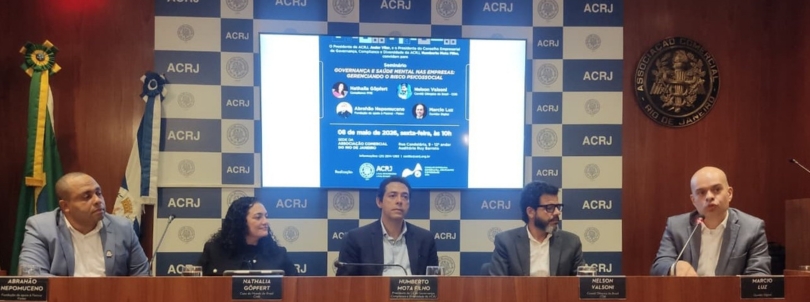
“Governance and Mental Health in Companies” was the theme of the seminar promoted by the Business Council of Governance, Compliance and Diversity of the ACRJ, held on May 8, which brought together specialists to discuss the challenges related to the management of psychosocial risks in the corporate environment. Attendees: Nathalia Göpfert (Compliance PME); Nelson Valsoni (Brazilian Olympic Committee – Comitê Olímpico do Brasil); Abrahão Nepomuceno (Fiotec’s support foundation for Fiocruz); and Márcio Luz (Digital Ombudsman).
The meeting brought together a broad participation of board members, executives, and professionals from the fields of governance, compliance, HR, occupational health, and risk management, in a debate marked by the exchange of practical experiences and reflections on the role of companies in building healthier, safer, and more sustainable organizational environments.
At the opening of the seminar, the Council’s president, Humberto Mota Filho, highlighted the importance of expanding the discussion on mental health within organizations from a strategic and multidisciplinary perspective. According to him, the topic is no longer solely related to well-being, but has come to occupy a central position in agendas concerning governance, organizational culture, and corporate risk management.
Throughout the meeting, the speakers addressed topics such as the increase in work absences related to mental health in Brazil, the impacts of the update to NR-1, the importance of preventing psychosocial risks, the integration between areas such as OSH (Occupational Safety and Health), HR, and Compliance, as well as the role of leadership and organizational culture in preventing harassment and mental health-related illness in the workplace.
Representing Fiotec at the meeting, Abrahão Nepomuceno, Coordinator of Integrity and Compliance, highlighted the importance of organizations integrating their Compliance, Human Resources, Occupational Health and Safety, and Risk Management teams as a critical factor for mapping and preventing psychosocial risks. “It is very important that we prepare in a structured way to meet the new regulatory requirements. Debates such as this highlight that compliance with NR-1 should be treated as a strategic governance agenda, aimed at building healthier, more responsible, and more sustainable work environments.”
Challenges faced by companies in the practical implementation of the new regulatory requirements were also discussed, with the aim of preventing mental health from being treated merely as a formal compliance obligation. The use of technology, reporting channels, and tools for mapping psychosocial risks was identified as an important ally in strengthening prevention, organizational listening, and data-driven decision-making based on indicators. The seminar also reinforced the need for integrated action between governance, people management, and control functions to transform mental health into a continuous agenda of prevention, culture, and organizational sustainability.
At the end of the meeting, participants were left with the perception that the topic still has many developments and relevant issues to be further explored in future Council meetings, with a collective feeling of “wanting more” given the quality and relevance of the debate.


